

Marc Chagall

| Full Name: | Mark Zajárovich Shagálov. |
|---|---|
| Birth: | 1887, Belarus, Russian Empire. |
| Death: | 1985, France. |
| Style: | Modernism | Surrealism | Cubism. |
Marc Chagall is a French visual artist of Jewish Lithuanian family background, born in Belarus. With a joyful, religious, nostalgic, and optimistic character, he created paintings and works across various disciplines, including ceramics, stained glass, printmaking, and illustration. He is considered one of the fathers of modernism, and his work spans a wide range of modern styles, especially surrealism and cubism.
Driven by his vital concerns, at the age of 19 he began moving between the main art capitals of the world at that time: Saint Petersburg, Berlin, and Paris.
He experienced both the First and Second World Wars firsthand; the latter led to his flight to the United States in 1941, as he was considered a Nazi target due both to his Jewish origin and to his artistic style, which was deemed "degenerate" by the German regime.
In the United States he settled in New York, where he was recognized as one of the great figures of painting. In 1948, he returned permanently to France and settled on the French Riviera, Nice, where he lived until his final days.
Chagall Paintings
His works are distinctive, rich in unusual ideas, magical settings, and mysterious worlds. They are exhibited in the most important museums in the world, across Russia, Europe, and the United States.
Chagall Paintings
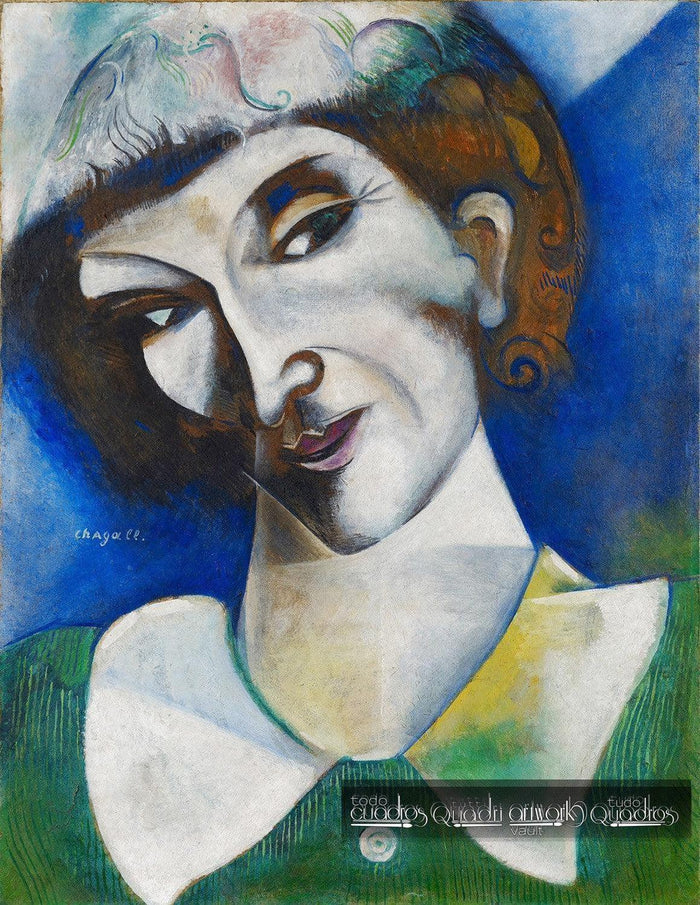
1. Self-Portrait
| Author: | Marc Chagall |
|---|---|
| Original Title: | Portrait de l'artiste |
| Type: | Painting |
| Style: | Modernism |
| Medium | Oil |
| Support: | Cardboard |
| Year: | 1914 |
| Genre: | Retrato |
| Located: | Basel Art Museum (Kunstmuseum Basel), Switzerland |
Marc Chagall often portrayed himself in his works, always in a non-realistic way. For him, depicting the state of mind was paramount.
This self-portrait is a symphony of strong colors and geometric shapes, prompting reflection at a historical moment where the importance of the individual seems to have faded in comparison to the importance of the collective as a whole.
A masterpiece where the painter perfectly intertwines Cubism and Fauvism.
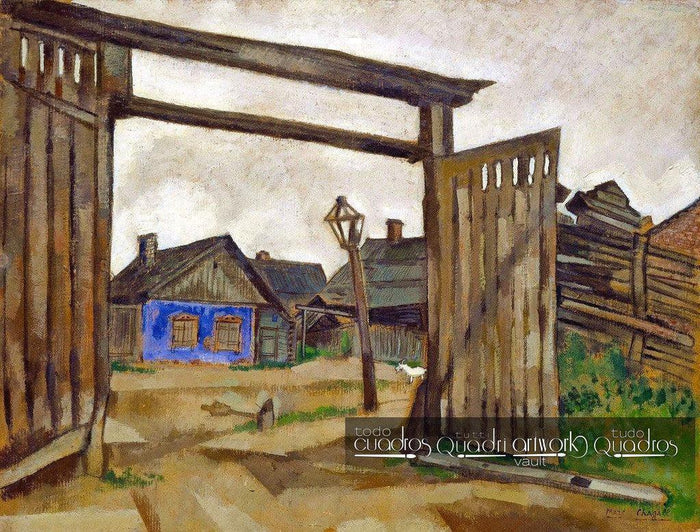
2. Houses at Vitebsk
| Author: | Marc Chagall |
|---|---|
| Original Title: | Maisons à Vitebsk |
| Type: | Painting |
| Style: | Modernism |
| Medium | Oil |
| Support: | Paper |
| Year: | 1917 |
| Located: | National Gallery of Art, Washington, USA |
In line with "The Grey House", this work is a nostalgic ode by the artist to the town where he grew up. The painting features areas with very vivid colors that contrast with the surroundings in brownish tones, denoting the great emotional load of the scene in the artist's mind.
3. White Crucifixion
| Author: | Marc Chagall |
|---|---|
| Original Title: | La Crucifixion blanche |
| Type: | Painting |
| Style: | Modernism |
| Medium | Oil |
| Support: | Canvas |
| Year: | 1938 |
| Genre: | Religious paintings |
| Located: | Art Institute of Chicago, USA |
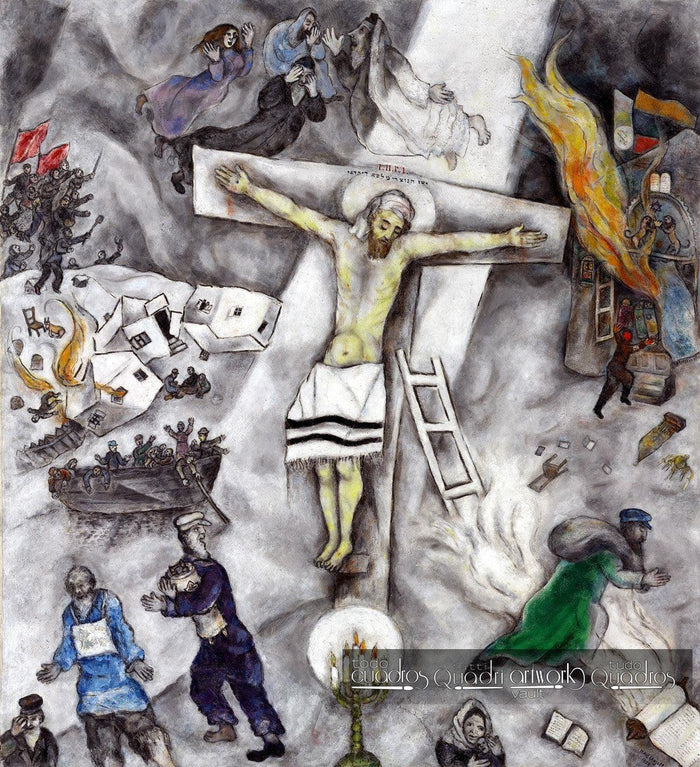
The painting shows Jesus crucified at the center and emphasizes his Jewish identity with various symbols:
The Tallit covering him (traditional shawl), the headscarf, and three figures, like angels floating from Sheol, observing this sad spectacle, speaking with a Haham (rabbi). A notable element is the Jewish lamp (the temple menorah) with seven branches, signifying the presence of the Lord, which Chagall has placed at Christ's feet. To the left and right, devastated towns, burned synagogues, and refugees fleeing by boat.
In the 1930s, this work was not without controversy, as it drew a parallel between the torment of Jesus and that of the Jewish people, at a time when the persecution of Jews was increasing, just three years before the Shoah (שואה), or the Nazi Holocaust, which began at the end of summer in 1941.
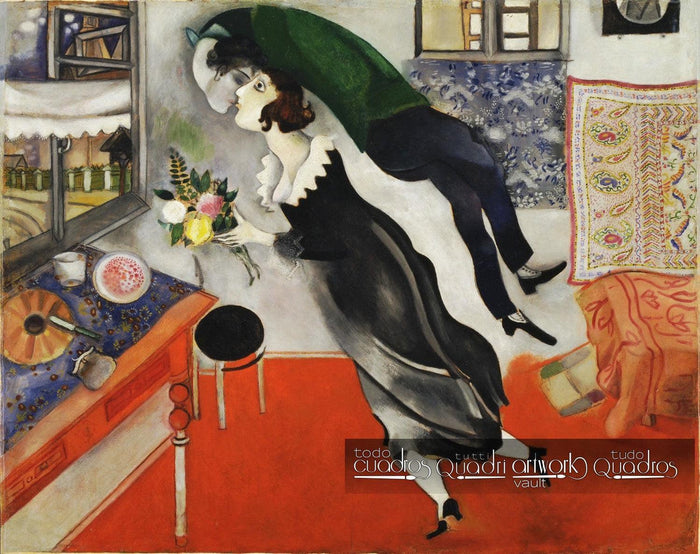
4. Birthday
| Author: | Marc Chagall |
|---|---|
| Original Title: | L'Anniversaire |
| Type: | Painting |
| Style: | Modernism |
| Medium | Oil |
| Support: | Canvas |
| Year: | 1915 |
| Located: | MoMA museum, New York. |
It represents the birthday of the artist himself, highlighting his greatest inspirations: love and fantasy, freedom and the joy of living. These were truly novel ideas in art, not found in other authors of his time.
5. The Blue Circus
| Author: | Marc Chagall |
|---|---|
| Original Title: | Le cirque bleu |
| Type: | Painting |
| Style: | Modernism |
| Medium | Oil |
| Support: | Canvas |
| Year: | 1950 |
| Located: | Tate Gallery, United Kingdom |
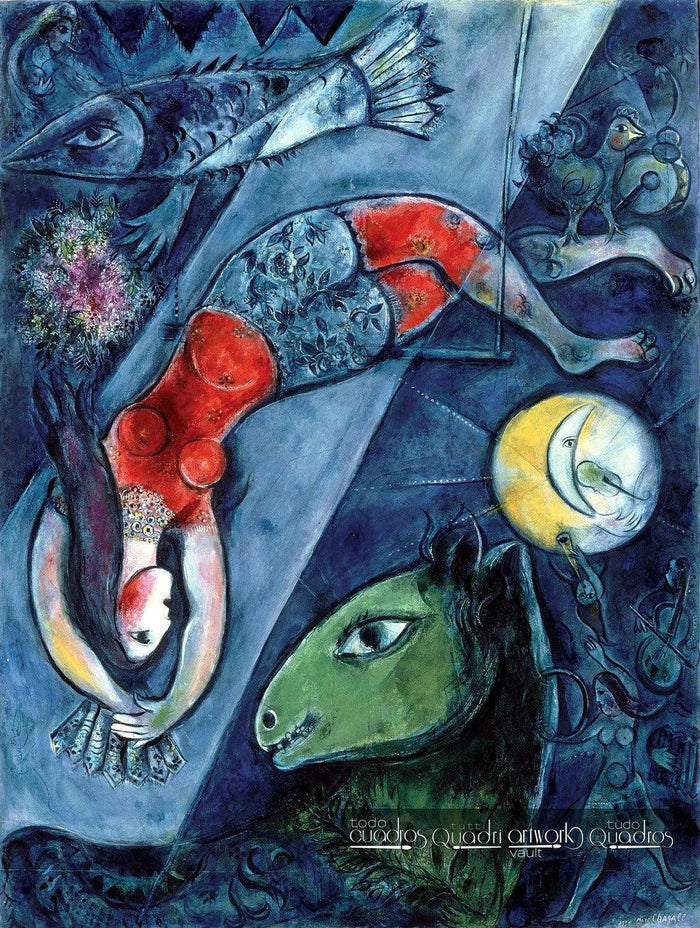
The main character is a trapeze artist, immersed in a fantastic world of music and circus. Painted in his later years, it shows a great sense of movement and rhythm, while the blue background makes the acrobat in bright red, jump towards the viewer's eyes.
This spectacle of crowds was one of the artist's favorite pictorial themes, who said:
"For me, the circus is a magical show that appears and disappears, like the world."
6. The Promenade
| Author: | Marc Chagall |
|---|---|
| Original Title: | La promenade |
| Type: | Painting |
| Style: | Cubism |
| Medium | Oil |
| Support: | Canvas |
| Year: | 1917 |
| Located: | Ruso Museum, Málaga |
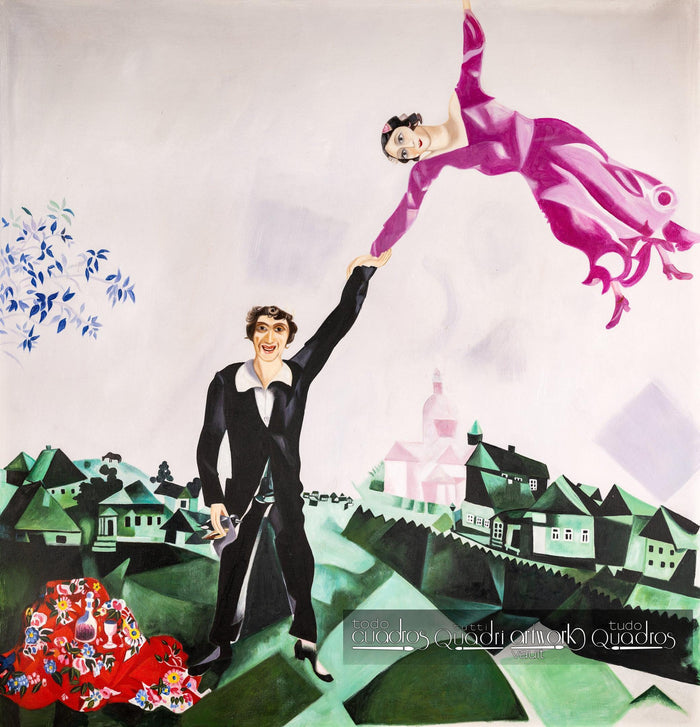
It is a song to joy and falling in love. It depicts a couple walking in the countryside and having a picnic. The woman flies to the right in a violet dress, gracefully holding the hand of her beloved, who holds a bird in the other hand and is elegantly dressed in a suit and shoes. In the background, a village with green houses and a pink temple.
7. Green Violinist
| Author: | Marc Chagall |
|---|---|
| Original Title: | Le violoniste vert |
| Type: | Painting |
| Style: | Cubism |
| Medium | Oil |
| Support: | Canvas |
| Year: | 1924 |
| Located: | Solomon R. Guggenheim Museum, New York |
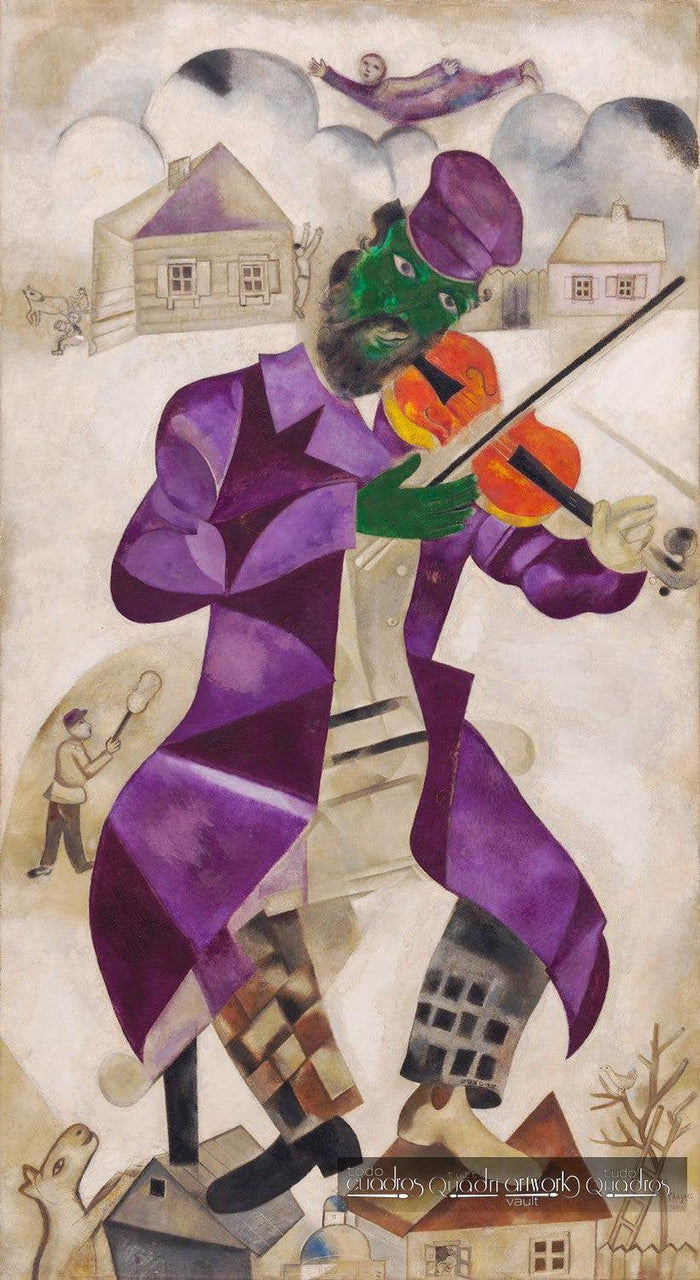
Chagall, already in Paris after an extended trip to Russia, gave birth to this great composition. In the background of the image, the city of Vitebsk represents nostalgia and melancholy about the past and rural settings for this impressive artist.
In the middle of the painting, a strong figure, the violinist, constructed with Cubist strokes, dominates the canvas, while also representing his Jewish origins.
8. The Grey House
| Author: | Marc Chagall |
|---|---|
| Original Title: | La maison grise |
| Type: | Painting |
| Style: | Cubism |
| Medium | Oil |
| Support: | Canvas |
| Year: | 1917 |
| Located: | Thyssen Museum, Madrid. |
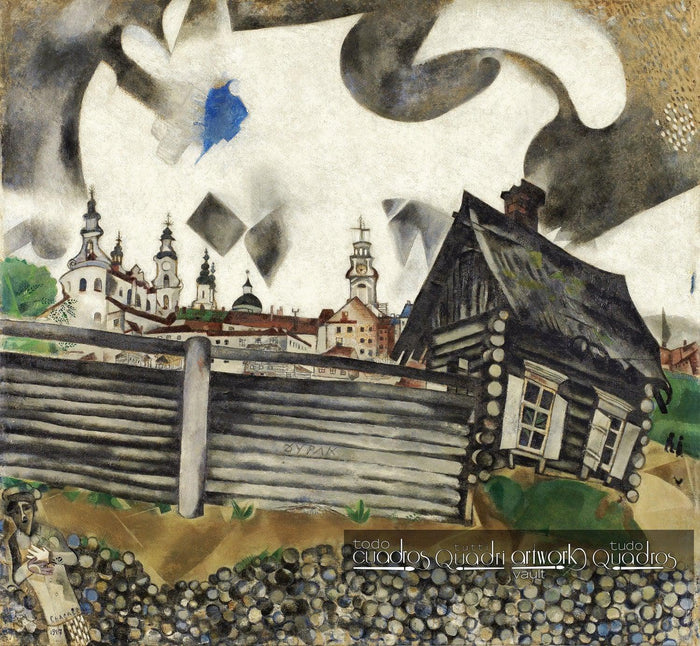
A composition with broken planes in the style of Cubism, to which Chagall was exposed during his stay in Paris and to which the master of Vitebsk added his style. Elements of certain realism are also discovered in this work. In the background, the real urban landscape of his beloved hometown is depicted. In the foreground is a typical wooden house of his time.
It's a painting that is playful in its forms and melancholic in its colors. On the left is a mysterious character, with "Chagall" written on the lower part of his jacket and, on the sleeve of the man, the hebrew word "מארק" (Marc) can be read. Historians think it's very likely a representation of the artist himself.
9. The Creation of Man
| Author: | Marc Chagall |
|---|---|
| Original Title: | La création de l'homme |
| Type: | Painting |
| Style: | Modernism |
| Medium | Oil |
| Support: | Canvas |
| Year: | 1958 |
| Located: | Marc Chagall Museum, Nice, France |
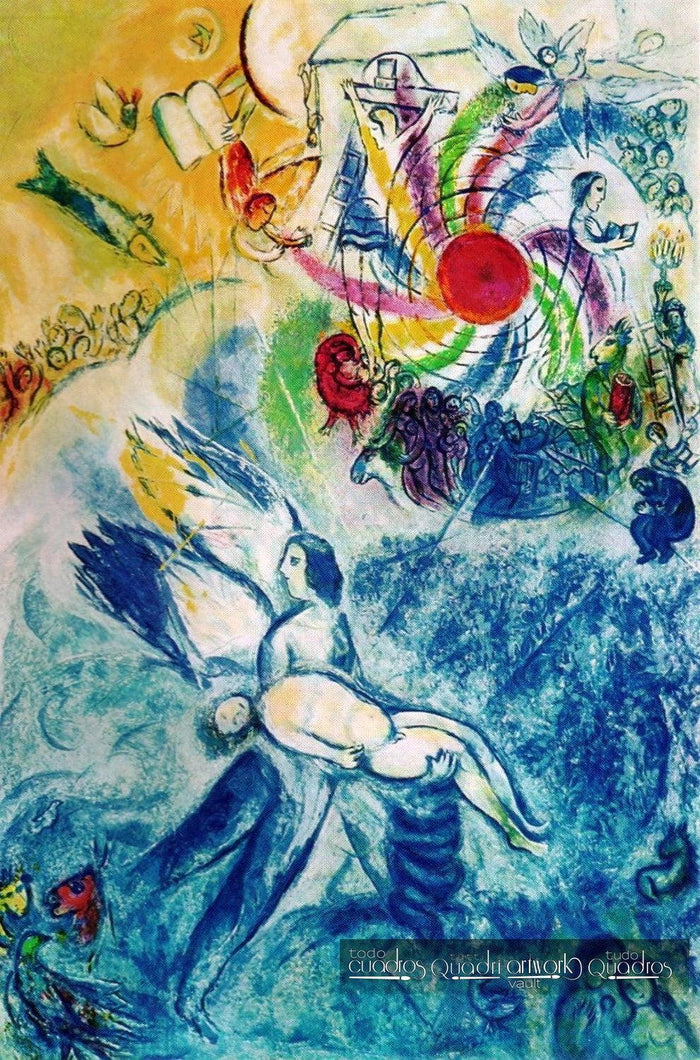
This is one of the artist's more formal and thoughtful religious paintings, certainly departing from the academic canon, but strict in the Judeo-Christian symbolic canon. It depicts the biblical story from Genesis and parts of the Gospels, where God completes the creation of man.
The sky is portrayed with yellow light and red, the sun, around which the Jewish people have revolved from ancient times to the crucifixion of Christ. The lower part shows Adam in the arms of the angel, amidst creation.
10. The Madonna of the Village
| Author: | Marc Chagall |
|---|---|
| Original Title: | La Madone du village |
| Type: | Painting |
| Style: | Modernism |
| Medium | Oil |
| Support: | Canvas |
| Year: | 1940-42 |
| Genre: | Religious paintings |
| Located: | Thyssen Museum, Madrid. |
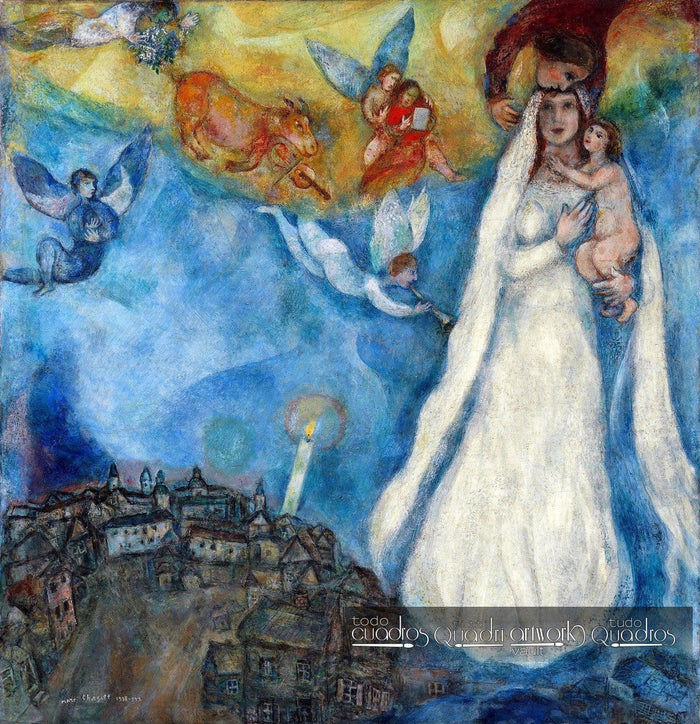
This canvas clearly showcases the painter's joyful and dreamy character. It took him two years to complete, starting in France when Hitler's army was beginning to advance and ravage the French borders, and finished two years later in New York, where he lived at 4 E 74th St, for approximately seven years, from 1941 to 1948.
The painting is filled with vivid colors that convey immense joy and hope. The work shows the Virgin with the child in her arms, dressed as a bride with fluttering angels around, a donkey, and a flying violin amidst a grand feast, over a small and gloomy village, yet illuminated by this small light (The Virgin), where the main character seems to invite the viewer to this great festivity.
Some experts believe that the man kissing her forehead might be Chagall himself, thanking the Madonna for having escaped the Nazi genocide.
11. I and the Village
| Author: | Marc Chagall |
|---|---|
| Original Title: | Moi et le village |
| Type: | Painting |
| Style: | Cubism |
| Medium | Oil |
| Support: | Canvas |
| Year: | 1911 |
| Located: | MoMA museum, New York. |
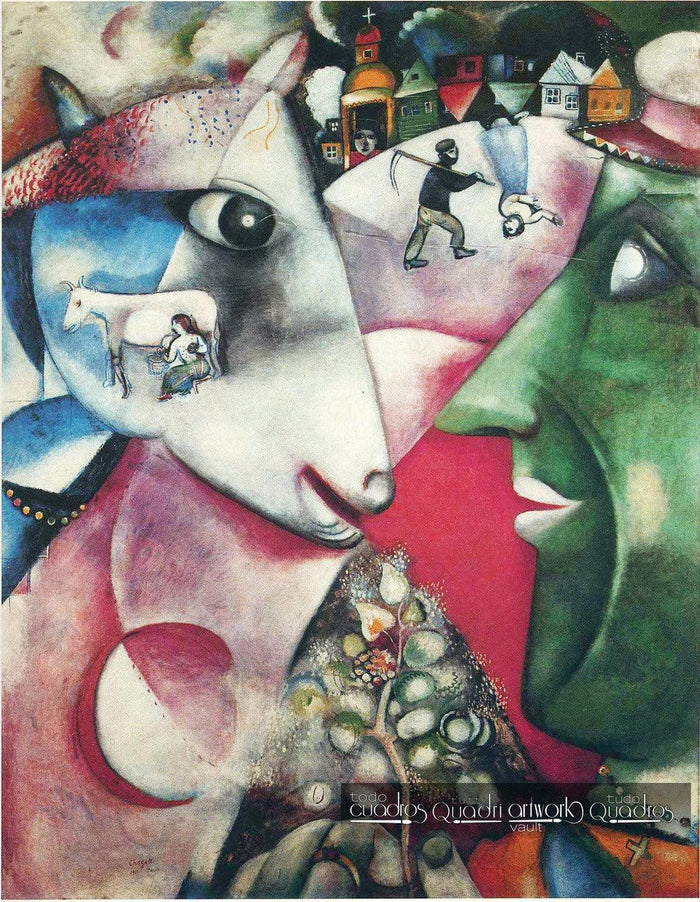
This is the most well-known work of Chagall. The composition merges elements with the greatest emotional charge that the artist experienced during his childhood, in the rural setting on the outskirts of Vitebsk, at 11 Pakroŭskaja Street, in Belarus. It features the labor of the land, peasants, livestock, houses, an Orthodox church, and at the bottom, a small tree symbolizing the origin and diversity of life. Although it contains many elements of Cubism, it cannot be purely classified as such due to the rural theme and the use of symbolism.
In the artist's opinion:
"For the Cubists, a painting was a surface covered with forms in a certain order. For me, a painting is a surface covered with representations of things, where logic and illustration have no importance."
12. Paris through the Window
| Author: | Marc Chagall |
|---|---|
| Original Title: | Paris par la fenêtre |
| Type: | Painting |
| Style: | Modernism |
| Medium | Oil |
| Support: | Canvas |
| Year: | 1913 |
| Located: | Solomon R. Guggenheim Museum, New York |
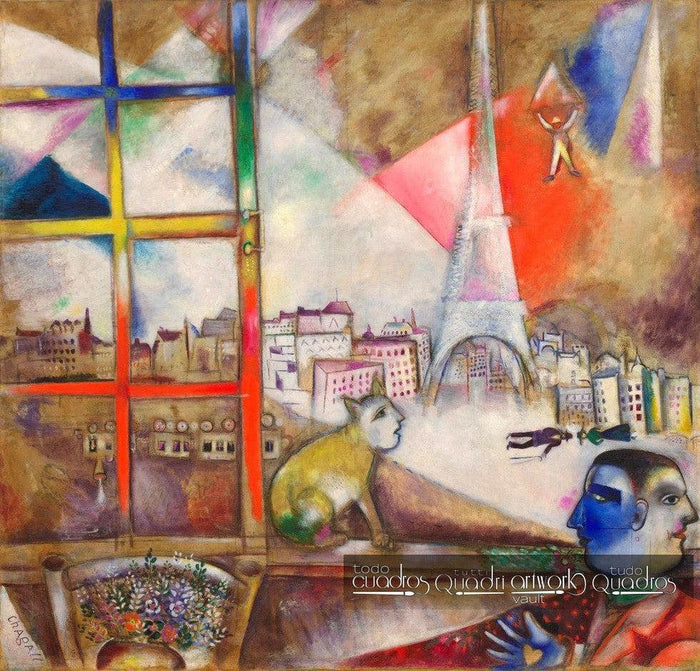
This avant-garde painting portrays a colorful landscape of Paris, the artist's favorite city, seen from a flowered balcony. The sky and the window exude vivid colors.
The main character, seemingly a self-representation of the artist, is a two-toned man with pairs of complementary colors depicting dualities: night and day life, bohemia and loneliness, as well as love and heartbreak. The scene contrasts his innocent childhood in Vitebsk with his life in a vibrant, unrestrained Paris of the Belle époque.
The painting includes mysterious and humorous elements, such as a parachutist holding himself and unusual figures, reflecting the painter's rich and complex artistic life.
Buy it in the Chagall oil paintings section
Related famous painters:
↑Back to top